You probably don’t check the 10-year U.S. Treasury yield very often.
Most people don’t.
But there’s a good reason to pay attention now.
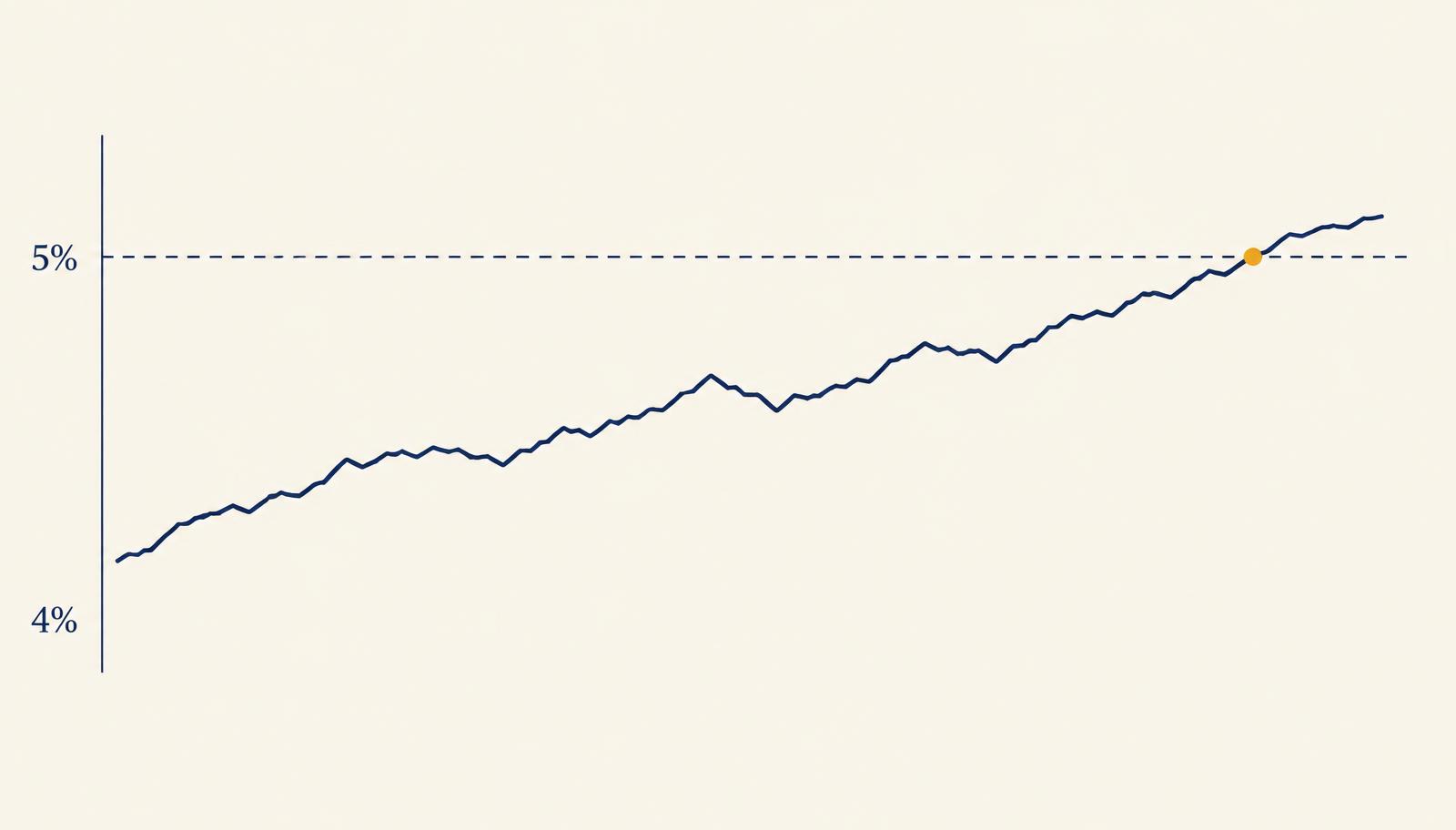
The yield on the 10-year Treasury recently moved above 5%, reaching levels not seen since 2007. On September 24, the official Treasury data showed a daily yield of 5.11%, after briefly moving higher during trading.
That’s a big move.
At the beginning of 2026, the 10-year yield was around 4.2%.
Now it’s above 5%.
So why should anyone outside Wall Street care?
Because the 10-year Treasury is one of the most important prices in the entire financial system.
And right now, the question isn’t simply why has it risen?
It’s:
What happens if rates this high become normal?
First, what exactly is the 10-year yield?
Think of a Treasury bond as a loan you make to the U.S. government.
The government promises to pay interest and return your money when the bond matures.
The yield is essentially the return investors currently demand for lending money to the government for 10 years.
There’s an important wrinkle, though.
The government doesn’t simply decide what the 10-year yield will be.
The Treasury sets the terms of its bonds, but the market determines their price.
When investors sell existing bonds, their prices fall.
And because bond prices and yields move in opposite directions, falling bond prices mean rising yields.
That’s what’s been happening recently.
Why are yields rising?
There isn’t one simple explanation.
Several forces are pushing in the same direction.
Inflation is still a concern
The September 2026 Federal Reserve projections put core PCE inflation at 3.4% for 2026, well above the Fed’s 2% longer-run target. The Fed’s median projection has inflation returning to 2% by 2029.
Investors lending money for ten years naturally care about what that money will be worth in ten years.
If inflation stays higher for longer, investors generally demand a higher yield.
The economy has been stronger than expected
Recent economic surveys showed surprisingly strong business activity, accompanied by renewed price pressures. That combination—strong growth plus persistent inflation—is particularly uncomfortable for the bond market because it can mean interest rates stay higher for longer.
The government needs to borrow enormous amounts of money
The U.S. has accumulated more than $40 trillion of debt, while the federal budget deficit remains historically large outside of a traditional crisis period.
That doesn’t mean government debt automatically causes Treasury yields to rise.
But the amount of debt being issued matters because the Treasury market has to absorb enormous quantities of government borrowing.
And investors have other places to put their money.
Large corporations, including technology companies financing the AI boom, are also borrowing heavily.
That creates competition for investors’ dollars.
But here’s something that seems strange
The Fed just raised interest rates.
On September 16, the Federal Reserve raised its target federal-funds rate to 3.75%–4.00%, its first rate increase since 2023.
You might assume that the Fed raising short-term rates explains everything.
It doesn’t.
The Fed has much more direct control over short-term interest rates.
The 10-year Treasury is different.
Its yield reflects what investors expect about inflation, economic growth, future interest rates and the compensation they want for taking on long-term interest-rate risk.
That’s why the 10-year can move substantially even when the Fed isn’t moving in the same direction.
So what does 5% mean for you?
Here’s where the story becomes much more interesting.
If you’re saving money
Higher interest rates aren’t necessarily bad.
For years, savers endured extraordinarily low returns on safe investments.
A world in which government bonds yield around 5% can provide substantially more income to people who want relatively conservative investments.
That’s particularly relevant in retirement.
Higher rates can give savers another option besides taking additional stock-market risk to generate income.
But remember: a 5% nominal yield isn’t the same thing as a 5% increase in purchasing power.
Inflation still matters.
If you’re borrowing money
This is the other side of the equation.
Higher long-term Treasury yields can put upward pressure on mortgages and other long-term borrowing costs.
A 10-year Treasury yield isn’t the same thing as a mortgage rate, and mortgage rates include additional costs and risks. But the two are closely related.
That means higher Treasury yields can make buying or refinancing a home more expensive.
And it isn’t only houses.
Corporate borrowing becomes more expensive too.
Eventually, companies have to decide whether a new factory, acquisition, expansion—or massive AI data center—is still worth financing at higher interest rates.
What about stocks?
This is where things get complicated.
Stocks compete with bonds for investors’ money.
If a Treasury bond offers a very low return, investors may be willing to pay relatively high prices for stocks because they have few attractive alternatives.
But if a relatively safe Treasury offers 5% or more, the calculation changes.
Investors can demand a greater return from riskier assets.
That can put pressure on stock valuations, particularly companies whose expected profits are far in the future.
It doesn’t mean stocks must fall when Treasury yields rise.
Stocks can rise at the same time if economic growth and corporate profits are strong enough.
That’s exactly why this isn’t a simple “rates up, stocks down” story.
And there’s an interesting effect on existing bonds
Suppose you own a 10-year Treasury that yields 3%.
Now imagine newly issued 10-year Treasuries are yielding 5%.
Why would someone pay you full price for your 3% bond when they can buy a new one yielding 5%?
They probably wouldn’t.
Your older bond becomes less valuable in the market.
That’s why rising yields can produce losses in existing long-term bond holdings—even though the bonds will eventually pay their promised principal if held to maturity, assuming the U.S. government makes the payments as promised.
There’s an important silver lining, though.
New bonds purchased at higher yields can provide substantially more income.
That’s one reason higher yields aren’t automatically bad for bond investors.
What happens to the federal government?
This may be the part that matters most over the long term.
The U.S. government has to refinance debt continually as old Treasury securities mature.
If the government has to borrow at higher interest rates, the cost of servicing the national debt eventually rises.
The effect doesn’t happen all at once because much of the existing debt was issued at older, lower rates.
But as old debt matures and is replaced with new debt, today’s higher rates gradually become tomorrow’s interest expense.
That can make the government’s fiscal situation more difficult.
So where does the 10-year yield go from here?
This is the question everybody wants answered.
And it’s also the question where we should be careful.
Nobody knows.
There are arguments for both directions.
Yields could fall if economic growth slows, inflation continues to decline and investors begin expecting lower future interest rates.
Yields could remain elevated or rise further if inflation stays stubborn, economic growth remains strong, government borrowing remains heavy, or investors demand greater compensation for holding long-term Treasury debt.
The Fed’s own September projections provide an interesting clue about the uncertainty: policymakers’ projected federal-funds rates for 2029 range from 2.9% to 3.9%.
That’s quite a range.
And remember: the federal-funds rate isn’t the 10-year Treasury yield.
The point is that even the people setting short-term monetary policy don’t know precisely where interest rates will settle years from now.
Neither does anyone else.
The number I’d watch isn’t necessarily 5.2%
It’s whether 5% becomes normal.
A brief move above 5% is one thing.
A sustained period in which investors routinely demand 5% or more to lend to the U.S. government for ten years would be something considerably more important.
It would mean the financial world has adjusted to a higher long-term cost of capital.
That could affect everything from housing affordability to corporate investment, government interest expense, stock valuations and retirement portfolios.
And it could also create opportunities.
Higher yields mean higher potential income for savers and new bond buyers.
That’s the fascinating thing about markets:
The same development can create problems for one person and opportunities for another.
The takeaway
The 10-year Treasury yield probably isn’t going to become part of your daily breakfast conversation.
It doesn’t need to.
But when it moves from roughly 4% to above 5%, it’s worth understanding why.
Because the 10-year Treasury isn’t just a Wall Street number.
It’s one of the prices that helps determine what money costs, what savings can earn, what homes cost to finance, how investors value assets, and how expensive it is for the government to borrow.
And right now, the bond market is asking a fascinating question:
Is 5% a temporary detour—or are we entering a world where higher long-term interest rates are simply normal again?
We don’t know the answer yet.
But it’s worth watching.
Evidence: Strong
This article explains how the 10-year Treasury yield works and what a higher yield can mean for savers, borrowers, investors, and the federal government, based on official data and public reporting. It is general public information, not individualized financial or investment advice. Markets move and past patterns do not guarantee future results—verify current figures with official sources before making a financial decision.
Official sources
- U.S. Department of the Treasury / Federal Reserve — Daily Treasury yield data
- Federal Reserve — Summary of Economic Projections, September 16, 2026
- Federal Reserve Bank of Boston — Why Mortgage Rates Exceed Treasury Yields
- Reuters — US bond yields barrel past 5%
- Axios — Why Treasury yields are ripping higher
About this information
Senior Life Watchdog provides general public information and is not a government agency, law firm, financial advisory service, or healthcare provider. This information is intended to help readers understand changes and locate official resources. Rules can change and individual eligibility depends on your circumstances. Always verify important information with the appropriate government agency or qualified professional before making financial, legal, or healthcare decisions.
Last verified: September 27, 2026
We’ll update this page when official information changes.
VERIFY THE INFORMATION
- Source:
- U.S. Department of the Treasury
- Official publication:
- Daily Treasury Par Yield Curve Rates
- Last verified by Senior Life Watchdog:
KNOW SOMEONE WHO SHOULD SEE THIS?
If this information could help someone you know, share this alert with them.
GET THE WATCHDOG ALERT
Important changes. Scam warnings. Benefits updates. Only when something actually matters.
Your email address is used only for Senior Life Watchdog communications. We do not sell or share subscriber information.