
The Cholesterol Measurement That Tells Us More
For decades, LDL cholesterol (LDL-C) has been one of the primary measurements used to assess cardiovascular risk.
It's commonly called "bad cholesterol," and for good reason: LDL particles play an important role in the development of atherosclerosis, the buildup of plaque inside arteries.
But there is another measurement that may provide a more complete picture: Apolipoprotein B, commonly called ApoB.
The difference is surprisingly simple.
- LDL-C measures the amount of cholesterol carried inside LDL particles.
- ApoB measures the concentration of atherogenic particles circulating in the bloodstream.
Why does this matter? Because the number of particles circulating in the blood may tell us more about the opportunity for cholesterol-containing particles to enter and become trapped in artery walls than the amount of cholesterol they happen to be carrying.
1. Think of Cholesterol Particles as Delivery Trucks
Imagine that cholesterol particles are delivery trucks transporting cholesterol through your bloodstream.
LDL-C tells us how much cargo is being transported.
ApoB gives us an indication of how many trucks are making those deliveries.
Consider two people with exactly the same LDL-C:
| Measurement | Person A | Person B |
|---|---|---|
| LDL-C | 70 mg/dL | 70 mg/dL |
| ApoB | 50 mg/dL | 85 mg/dL |
| Relative particle burden | Lower | Higher |
Both people have the same LDL cholesterol level, but Person B has a substantially higher concentration of ApoB-containing particles.
In other words, the same amount of cholesterol is being carried by more particles.
This is possible because individual particles can carry different amounts of cholesterol.
The important point: Two people can have identical LDL-C levels but different numbers of potentially artery-damaging particles.
2. Why Does the Number of Particles Matter?
Atherosclerosis is not simply caused by cholesterol floating around in the bloodstream.
It is a biological process involving the entry and retention of certain lipoprotein particles within the artery wall.
Here's what happens:
- ApoB-containing particles circulate through the bloodstream.
- Some particles enter the artery wall.
- Some become retained within the artery wall.
- This triggers inflammatory and immune responses.
- Over time, plaque can develop and progress.
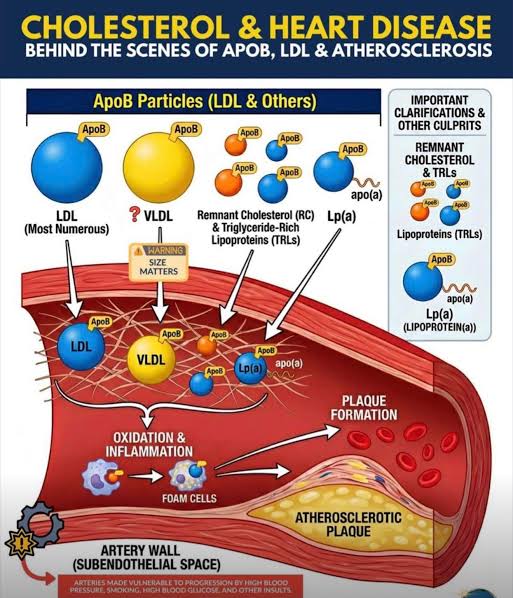
The particles that matter include LDL, VLDL remnants, IDL and lipoprotein(a), or Lp(a).
Each of these particles carries one ApoB molecule.
Consequently, measuring ApoB provides an estimate of the total concentration of these atherogenic particles.
The more particles circulating, the greater the number of opportunities for them to enter and become retained in artery walls.
This is why particle number is so important when assessing cardiovascular risk.
3. Why LDL-C Can Sometimes Be Misleading
LDL-C is a useful measurement, but it doesn't tell us how many particles are carrying that cholesterol.
This becomes particularly important when LDL-C and ApoB levels don't agree.
The medical term for this is discordance.
For example, someone might have:
- LDL-C of 55 mg/dL, which appears excellent.
- ApoB of 85 mg/dL, indicating a higher concentration of atherogenic particles than the LDL-C level alone might suggest.
This doesn't mean the LDL-C measurement is wrong. It means that LDL-C and ApoB are measuring different aspects of the same underlying biology.
Discordance is more common in people with elevated triglycerides, diabetes, metabolic dysfunction and certain other lipid abnormalities. It can also occur in people taking cholesterol-lowering medication.
When the two measurements disagree, research generally finds that ApoB provides a more reliable indication of atherogenic particle burden and associated cardiovascular risk.
4. What Does the Research Tell Us?
The evidence supporting ApoB has grown considerably.
National Lipid Association Consensus, 2024
An expert consensus published in the Journal of Clinical Lipidology concluded that ApoB and non-HDL cholesterol can provide more accurate cardiovascular risk assessment than LDL-C, particularly when the measurements are discordant.
The authors emphasized that ApoB complements the standard cholesterol panel and can help guide treatment decisions.
Systematic Review, 2025
A systematic review examined 15 studies involving 593,354 participants.
The researchers found that ApoB outperformed LDL-C in all nine studies that directly compared their predictive performance in populations with discordant measurements.
This provides substantial evidence that measuring particle concentration can improve cardiovascular risk assessment.
UK Biobank Study, 2025
A study involving 375,544 participants examined differences between LDL-C and ApoB and their relationship with cardiovascular events.
People whose ApoB was disproportionately high relative to LDL-C had an 11% higher relative risk of major cardiovascular events compared with the concordant group.
Those with disproportionately low ApoB had a 13% lower relative risk.
The study supports the importance of identifying people whose LDL-C may underestimate their atherogenic particle burden.
These findings are observational, however, and do not establish that measuring ApoB or targeting a particular ApoB level independently reduces heart attacks.
5. Why ApoB Is Particularly Useful When Taking Statins
Cholesterol-lowering medications, particularly statins, reduce LDL-C and generally reduce ApoB as well.
However, the reductions are not always proportional.
A person might achieve an LDL-C level that appears to be at an excellent target while still having a higher-than-expected ApoB.
This is one reason ApoB can be useful for people already receiving treatment.
It can help identify residual lipoprotein-related risk that may not be apparent from LDL-C alone.
The distinction is particularly relevant for people with established cardiovascular disease, diabetes, elevated triglycerides or other metabolic risk factors.
Importantly, a higher ApoB doesn't automatically mean medication should be increased. Treatment decisions should consider the complete risk profile, current treatment, LDL-C, non-HDL-C and the individual's circumstances.
6. What Do the 2026 Cholesterol Guidelines Say?
The 2026 ACC/AHA multisociety cholesterol guidelines recognize the value of ApoB testing.
They recommend that measuring ApoB is reasonable in adults already receiving lipid-lowering treatment, particularly those with:
- Established atherosclerotic cardiovascular disease.
- Cardiovascular-kidney-metabolic syndrome.
- Type 2 diabetes.
- Elevated triglycerides.
The purpose is to help guide decisions about further treatment, particularly when LDL-C and/or non-HDL-C goals have already been achieved.
The guidelines do not replace LDL-C with ApoB.
Instead, they recognize that the two measurements provide different and complementary information.
This is an important development in how cardiovascular risk is assessed.
7. Should Everyone Have an ApoB Test?
Not necessarily.
A standard lipid panel remains an appropriate starting point for most people.
However, ApoB may be particularly informative when:
- You have established coronary artery disease.
- You have a high coronary artery calcium score.
- Your LDL-C is low but you want to assess residual particle burden.
- You have elevated triglycerides.
- You have diabetes or metabolic syndrome.
- You are taking cholesterol-lowering medication and want a more complete assessment.
ApoB is a relatively inexpensive blood test and can usually be added to routine blood work.
There is no need to choose between LDL-C and ApoB. In many circumstances, measuring both provides a more complete picture.
The Watchdog Takeaway
LDL-C remains an important measurement, and lowering LDL cholesterol has strong evidence behind it for reducing cardiovascular events.
But LDL-C doesn't tell us how many atherogenic particles are carrying that cholesterol.
ApoB provides that additional information.
For someone with coronary artery disease, a high calcium score or an apparently excellent LDL-C level, knowing the ApoB level may reveal important information that a conventional cholesterol panel misses.
The bottom line: LDL-C tells us how much cholesterol is being transported. ApoB tells us how many potentially artery-damaging particles are transporting it. Both matter, but ApoB can give us a more complete picture of cardiovascular risk.
Evidence Assessment: STRONG
There is substantial evidence supporting ApoB as a measure of atherogenic particle burden and as a useful addition to conventional cholesterol testing. Its advantage over LDL-C is particularly well established when the two measurements are discordant.
The evidence does not mean ApoB should replace LDL-C, nor does it establish a single treatment target appropriate for everyone.
Sources and Further Reading
2026 ACC/AHA Multisociety Guideline on the Management of Dyslipidemia – Current recommendations on ApoB testing and cardiovascular risk management.
https://www.ahajournals.org/doi/10.1161/CIR.0000000000001423
National Lipid Association – ApoB Expert Consensus (2024) – Detailed review of ApoB's role in cardiovascular risk assessment.
ApoB, LDL-C and Non-HDL-C as Markers of Cardiovascular Risk (2025) – Systematic review of 15 studies involving 593,354 participants.
UK Biobank Study – ApoB and LDL-C Discordance (2025) – Research involving 375,544 participants examining differences in cardiovascular outcomes.
Senior Life Watchdog does not recommend starting, stopping or changing medication. Treatment decisions should be made with an appropriately qualified healthcare professional.