
Statins are among the most extensively studied and effective medications for reducing cardiovascular risk. They lower LDL cholesterol, reduce the number of harmful ApoB-containing particles, and help stabilize atherosclerotic plaque.
But what about vitamin K2?
Recent clinical trials have renewed interest in whether vitamin K2, particularly the MK-7 form, might influence coronary artery calcification.
This raises an intriguing question:
Could combining statins with vitamin K2 provide additional benefits by addressing different aspects of atherosclerosis?
It's a reasonable scientific question. Here's what we know so far.
1. Statins: More than just lowering cholesterol
Atherosclerosis develops when ApoB-containing particles, including LDL, enter and become retained in artery walls. This contributes to inflammation, plaque formation, and eventually narrowing of the arteries.
Statins address one of the central drivers of this process.
They:
- Reduce LDL cholesterol and ApoB-containing particles.
- Reduce the accumulation of cholesterol within arterial walls.
- Reduce inflammation within atherosclerotic plaques.
- Help stabilize existing plaques.
- Reduce the risk of heart attacks, strokes, and cardiovascular death.
An important observation from imaging studies is that statin treatment can sometimes increase the calcium content and density of existing plaques while reducing their lipid-rich components.
This isn't necessarily bad.
Denser calcification can be associated with more stable plaque characteristics, although the relationship between calcium and plaque vulnerability is complex.
The important point is that successful statin treatment doesn't necessarily mean coronary calcium scores will decrease.
2. Vitamin K2: A different potential mechanism
Vitamin K2, particularly MK-7 (menaquinone-7), has attracted attention because of its role in activating certain proteins involved in calcium regulation.
Two proteins are particularly relevant:
Matrix Gla protein (MGP)
MGP helps inhibit inappropriate calcium deposition in blood vessels. It requires vitamin K to become fully activated.
Osteocalcin
Osteocalcin is involved in bone mineralization and also requires vitamin K for activation.
The theory is that adequate vitamin K2 may support normal calcium regulation in tissues, including blood vessels.
This is biologically plausible, but biological plausibility alone doesn't establish clinical benefit.
3. What do the newer clinical trials show?
Several recent studies have made this subject considerably more interesting.
VitaK-CAC trial (2026)
A randomized, placebo-controlled trial involving 180 people with coronary artery disease examined 360 micrograms of vitamin K2 MK-7 daily over two years.
The researchers found that participants receiving K2 experienced significantly slower progression of coronary artery calcium compared with the placebo group.
Importantly, both groups experienced some progression. K2 did not reverse existing calcification.
Most participants were also receiving statins, making the findings particularly interesting for people already receiving conventional cholesterol treatment.
However, the trial did not establish that K2 reduced heart attacks or improved survival.
Danish K2 and D3 research
Another randomized study investigated vitamin K2 combined with vitamin D3.
Some analyses suggested that the combination might influence calcium progression among participants taking statins.
However, the overall primary outcome was not statistically significant, and subgroup findings should be interpreted cautiously.
DANCODE trial (2026)
This study examined approximately 400 people with substantial coronary calcification.
Participants received either vitamin K2 combined with vitamin D3 or placebo for two years.
The researchers found significantly slower progression of coronary calcium in the treatment group.
However, the CCTA imaging analysis did not demonstrate a significant reduction in total plaque volume or noncalcified plaque volume.
This is an important distinction: slowing calcium accumulation does not necessarily mean reducing the amount of atherosclerotic plaque.
4. Could statins and K2 complement each other?
This is where things get interesting.
The two interventions potentially influence different biological processes.
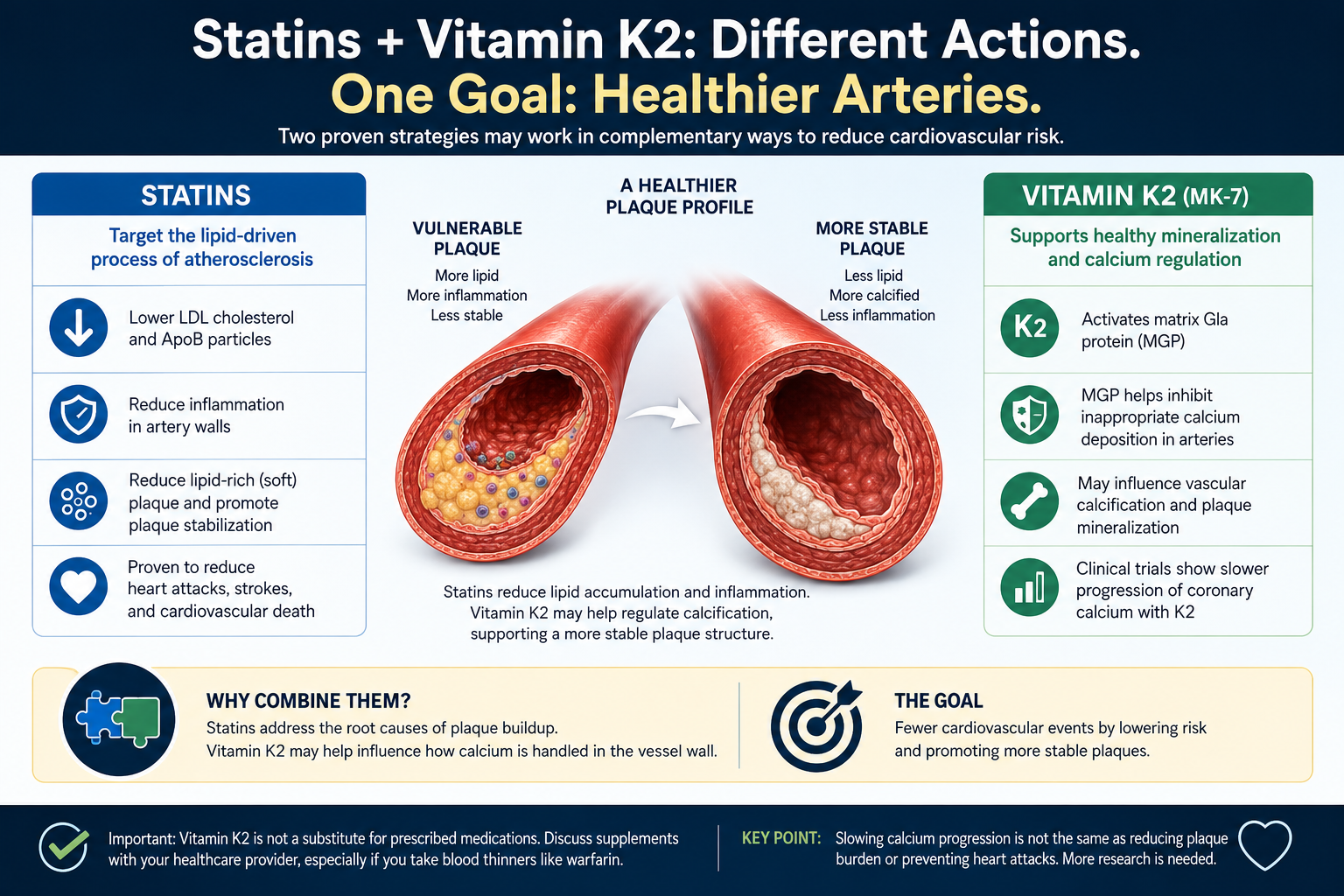
| Statins | Vitamin K2 |
|---|---|
| Reduce LDL and ApoB | Activates vitamin K-dependent proteins |
| Reduce cholesterol accumulation in arteries | May influence vascular mineralization |
| Help stabilize existing plaque | May regulate calcium deposition |
| Proven reduction in cardiovascular events | Cardiovascular benefit not yet established |
The hypothesis is that statins could reduce the lipid-driven process responsible for atherosclerosis while K2 influences the mineralization process.
Could the combination improve plaque composition more effectively than either treatment alone?
Possibly.
But there is currently no convincing randomized evidence demonstrating that adding K2 to statin therapy produces greater plaque stabilization or fewer cardiovascular events than statin therapy alone.
We should also remember that not all arterial calcification is harmful in the same way. The calcification associated with plaque stabilization is different from the inappropriate mineralization that K2 is proposed to help prevent.
5. What research would answer the question?
Ideally, researchers would conduct a large randomized trial comparing four groups:
- Statin treatment alone.
- Vitamin K2 alone.
- Statin treatment combined with K2.
- Placebo or appropriate control treatment.
Researchers would measure more than coronary calcium scores.
They would examine:
- Total coronary plaque volume.
- Noncalcified plaque volume.
- Low-attenuation plaque.
- Calcified plaque volume and density.
- Plaque characteristics associated with vulnerability.
- Ultimately, heart attacks, strokes, and cardiovascular deaths.
That would help establish whether the combination offers additional protection beyond conventional lipid-lowering treatment.
6. Should people with high CAC scores consider K2?
At present, vitamin K2 should be considered an investigational supplement rather than an established cardiovascular treatment.
There is emerging evidence that it may influence coronary calcium progression, but we don't yet know whether this translates into fewer cardiovascular events.
For people with established coronary artery disease, the priorities remain:
- Achieving appropriate LDL and ApoB targets.
- Taking prescribed lipid-lowering medications.
- Managing blood pressure.
- Avoiding smoking.
- Maintaining regular physical activity.
- Addressing diabetes and other cardiovascular risk factors.
Vitamin K2 should not replace or delay proven treatments.
People taking warfarin or other vitamin K antagonist medications should not start K2 without medical guidance because of potentially significant interactions.
THE WATCHDOG TAKEAWAY
There is a legitimate scientific reason to investigate combining statins and vitamin K2.
Statins have overwhelming evidence supporting their ability to reduce cardiovascular events. Newer randomized trials suggest that K2 may influence the progression of coronary calcification.
The possibility that these treatments could complement each other is interesting, but it remains a hypothesis rather than an established clinical benefit.
The distinction matters: slowing calcium progression is not the same as reducing plaque burden, preventing heart attacks, or extending life.
We need larger studies measuring actual plaque changes and cardiovascular outcomes before concluding that statins plus K2 are better than statins alone.
The science is developing. The evidence should determine what we believe, not the enthusiasm surrounding a supplement.
Evidence assessment: MODERATE for slowing coronary calcium progression; LIMITED for additional plaque stabilization or cardiovascular protection from combining K2 with statins.
Sources and Further Reading
Vossen LM, et al. Two Years of Menaquinone-7 Supplementation and Coronary Artery Calcification: A Randomized Clinical Trial. JAMA Cardiology, 2026 (VitaK-CAC).
https://jamanetwork.com/journals/jamacardiology/article-abstract/2850256
Hasific S, et al. Vitamin K2 and D3 Supplementation in Patients With Severe Coronary Artery Calcification: The DANCODE Trial. Circulation, 2026.
https://www.ahajournals.org/doi/10.1161/CIRCULATIONAHA.126.082363
Hasific S, et al. Effects of Vitamin K2 and D Supplementation on Coronary Artery Disease in Men: A RCT. JACC: Advances, 2023.
Nicholls SJ, et al. Effect of Evolocumab on Progression of Coronary Disease in Statin-Treated Patients: The GLAGOV Randomized Clinical Trial. JAMA, 2016.
Puri R, et al. Impact of Statins on Serial Coronary Calcification During Atheroma Progression and Regression. Journal of the American College of Cardiology, 2015.