
For people with established coronary artery disease, lowering LDL cholesterol and ApoB is one of the most important steps in reducing cardiovascular risk.
Medications such as statins and ezetimibe reduce the number of atherogenic particles circulating in the bloodstream. This helps reduce the cholesterol entering artery walls and slows the processes that lead to plaque formation and progression.
But there's another part of cardiovascular health worth considering.
What happens to the artery wall itself?
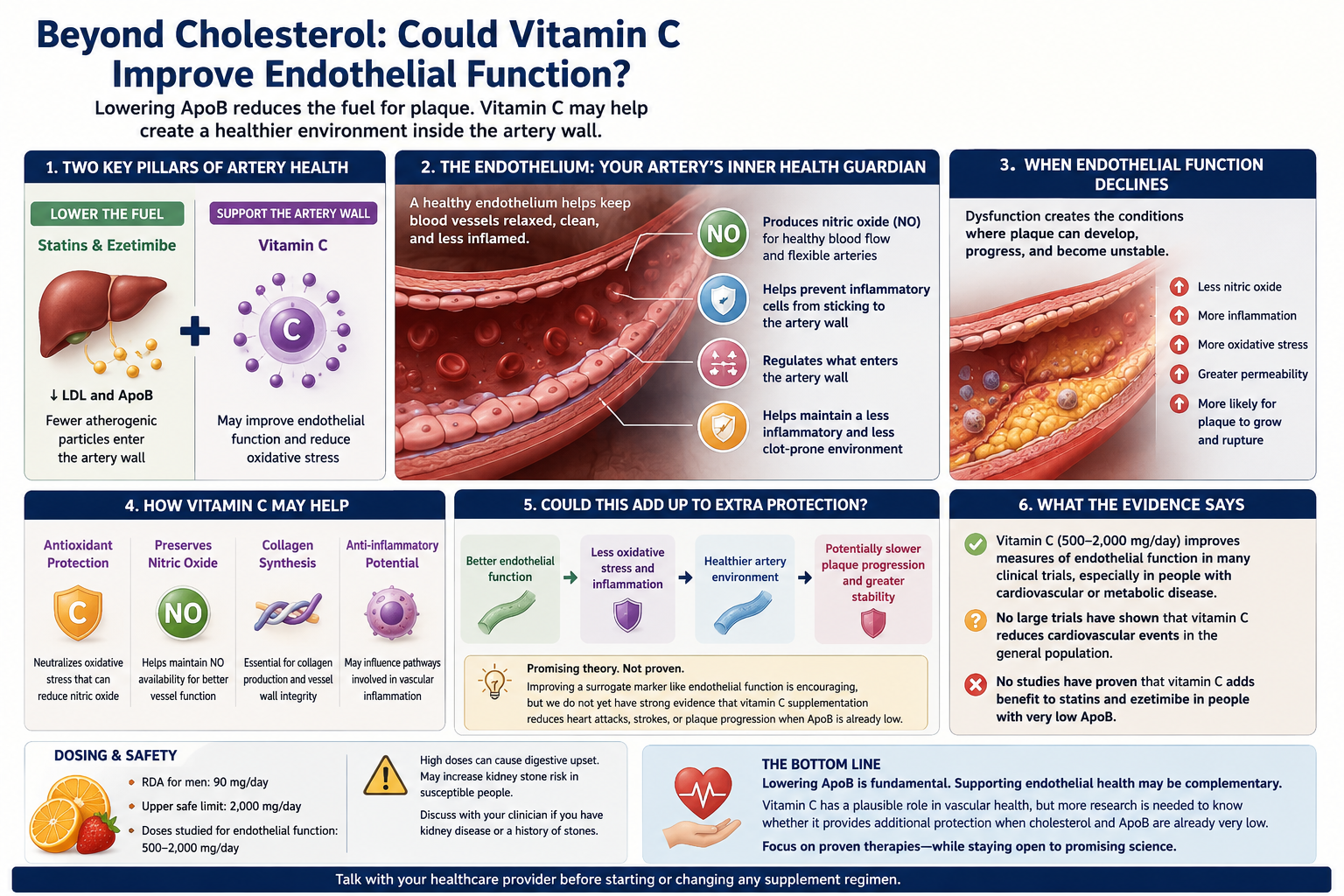
The inner lining of our arteries, called the endothelium, plays an important role in regulating blood flow, inflammation, blood vessel function, and the development of atherosclerosis.
Could improving its function provide additional protection, even when cholesterol and ApoB are already very low?
Vitamin C is one possible candidate.
1. Lowering ApoB Addresses a Major Cause of Atherosclerosis
ApoB is a measure of the number of potentially harmful cholesterol-carrying particles in the bloodstream.
These particles include LDL, VLDL remnants, and other particles capable of entering the artery wall.
When they become trapped in the artery wall, they can trigger inflammation and contribute to plaque development.
Statins and ezetimibe reduce this burden through different mechanisms:
- Statins reduce cholesterol production in the liver and increase the removal of LDL particles from the bloodstream.
- Ezetimibe reduces the absorption of cholesterol in the intestine, helping lower circulating LDL.
Clinical trials have established that lowering LDL and ApoB reduces cardiovascular events.
For someone who has already achieved a very low ApoB through treatment, however, another question arises:
Are there other biological processes that could be addressed to support artery health?
The answer is yes. Atherosclerosis involves much more than cholesterol alone.
2. Why the Endothelium Matters
The endothelium is a thin layer of cells covering the inside of blood vessels.
It is much more than a protective coating. It actively regulates the environment within our arteries.
A healthy endothelium:
- Produces nitric oxide, which helps arteries relax and maintain healthy blood flow.
- Helps prevent inflammatory cells from attaching to artery walls.
- Regulates the movement of substances into the artery wall.
- Helps maintain a less inflammatory and less thrombogenic environment.
- Contributes to normal blood vessel repair and function.
When endothelial function deteriorates, blood vessels become more vulnerable to processes involved in atherosclerosis.
Oxidative stress, high blood pressure, smoking, diabetes, and chronic inflammation can all contribute to endothelial dysfunction.
This is one reason cardiovascular researchers are interested in treatments that might improve endothelial health.
3. Where Vitamin C Comes In
Vitamin C is best known for its antioxidant properties, but it has several functions relevant to blood vessel health.
Antioxidant protection
Oxidative stress can interfere with nitric oxide, a molecule essential for normal blood vessel function.
Vitamin C can help reduce oxidative stress and may preserve nitric oxide availability.
Supporting endothelial function
By influencing oxidative stress and nitric oxide activity, vitamin C may improve the ability of blood vessels to relax and respond to changes in blood flow.
Collagen production
Vitamin C is essential for collagen synthesis. Collagen provides structural support to blood vessels and other connective tissues.
Potential effects on inflammation and plaque stability
Laboratory and other experimental research suggests vitamin C may influence inflammatory processes and vascular smooth muscle cell survival. These mechanisms are interesting, but their importance in preventing cardiovascular events through supplementation remains uncertain.
These functions provide a biological reason to investigate vitamin C as a possible complement to conventional cardiovascular treatment.
4. What Do Human Studies Show?
There is some encouraging clinical evidence.
A 2014 systematic review and meta-analysis published in the journal Atherosclerosis examined 44 randomized clinical trials investigating vitamin C supplementation and endothelial function.
The researchers found a statistically significant improvement in measured endothelial function among people taking vitamin C.
Interestingly, the improvement appeared greater in participants with existing cardiovascular or metabolic conditions, including:
- Atherosclerosis
- Diabetes
- Heart failure
The findings suggest that vitamin C may have a more noticeable effect in people whose blood vessel function is already impaired than in otherwise healthy individuals.
Another systematic review, published in 2015, also found improvements in endothelial function in trials using vitamin C alone at doses of 500–2,000 mg daily.
These findings are relevant because they demonstrate that vitamin C can influence measurable aspects of human blood vessel function.
However, endothelial function is a surrogate measurement. Improving it does not automatically demonstrate that plaque progression slows or that fewer heart attacks occur.
5. Could Vitamin C Add Something to Statins and Ezetimibe?
This is perhaps the most interesting question.
Statins and ezetimibe primarily reduce the number of atherogenic cholesterol particles.
Vitamin C works through different biological pathways.
The proposed combination would look something like this:
Statins and ezetimibe
- Reduce LDL and ApoB.
- Reduce the number of cholesterol particles entering artery walls.
- Help slow plaque development and progression.
- Reduce cardiovascular events.
Vitamin C
- Supports normal collagen production.
- May reduce oxidative stress.
- May preserve nitric oxide availability.
- May improve measured endothelial function.
In theory, these different actions could complement one another.
Lowering ApoB reduces the material contributing to plaque formation, while supporting endothelial function may help maintain a healthier environment within the artery wall.
This is a reasonable scientific hypothesis.
But there is an important limitation: we do not yet have convincing clinical trials demonstrating that adding vitamin C to intensive statin and ezetimibe treatment provides additional protection against coronary plaque progression or cardiovascular events.
It remains a research question rather than an established treatment strategy.
6. Why Haven't Large Studies Demonstrated a Cardiovascular Benefit?
This is where we need to be careful.
The Physicians' Health Study II was a large randomized trial involving 14,641 male physicians aged 50 and older.
Participants received 500 mg of vitamin C daily or a placebo and were followed for an average of eight years.
The study found no significant reduction in major cardiovascular events, heart attacks, strokes, or cardiovascular deaths.
The Women's Antioxidant Cardiovascular Study also found no overall reduction in cardiovascular events with vitamin C supplementation among women with a history of cardiovascular disease.
These findings cannot be ignored.
However, these trials were designed primarily to investigate cardiovascular events, not specifically to determine whether vitamin C improves endothelial function in people with established coronary disease who have already achieved very low ApoB levels through intensive lipid-lowering treatment.
That is a more specific question, and it has not been adequately answered.
It is also possible that supplementation offers little additional benefit when a person's vitamin C status is already adequate.
The evidence therefore supports further investigation, not a conclusion that supplementation provides additional cardiovascular protection.
7. How Much Vitamin C Is Reasonable?
The recommended daily intake for adult men is 90 mg.
The tolerable upper intake level for adults is 2,000 mg per day.
Some clinical trials investigating endothelial function have used doses between 500 and 2,000 mg daily.
However, the fact that a dose has been studied does not establish it as the optimal dose for cardiovascular protection.
Vitamin C absorption becomes less efficient as doses increase. Taking more does not necessarily produce greater biological benefit.
High doses can cause digestive problems and may increase urinary oxalate, potentially increasing kidney stone risk in susceptible individuals.
People with a history of kidney stones, kidney disease, or certain iron-overload conditions should be particularly cautious.
For most people, a balanced diet containing vitamin C-rich foods remains the foundation of adequate intake.
Supplementation should be considered in the context of individual health, diet, and medical history.
8. What Research Would Actually Answer This Question?
A useful clinical trial would recruit people with established coronary artery disease who are already receiving intensive lipid-lowering treatment and have achieved low LDL and ApoB levels.
Participants could be randomly assigned to receive vitamin C or a placebo while continuing their usual treatment.
Researchers could then measure:
- Endothelial function using flow-mediated dilation.
- Markers of oxidative stress and inflammation.
- Coronary plaque volume and composition using appropriate imaging.
- Changes in plaque progression over time.
- Ultimately, cardiovascular events in a sufficiently large and long-term study.
This would help establish whether vitamin C provides a measurable benefit beyond what is already achieved through cholesterol-lowering treatment.
It would also help identify whether any benefit depends on baseline vitamin C levels, the presence of endothelial dysfunction, or the dose used.
Until such evidence is available, we should not assume that improving one biological marker necessarily translates into fewer cardiovascular events.
THE WATCHDOG TAKEAWAY
Lowering ApoB is fundamental to preventing and managing atherosclerosis, but it does not address every biological process involved in cardiovascular disease.
The endothelium plays an important role in artery health, and randomized trials suggest that vitamin C supplementation can improve some measures of endothelial function, particularly in people with existing cardiovascular or metabolic conditions.
This raises an interesting possibility: vitamin C might provide complementary biological benefits alongside statins and ezetimibe.
However, there is currently no convincing evidence that adding vitamin C to intensive cholesterol-lowering treatment slows coronary plaque progression or reduces heart attacks and strokes.
The idea is scientifically plausible and deserves further research. But a promising mechanism is not the same as a proven cardiovascular treatment.
Evidence Level
- ApoB reduction and cardiovascular risk reduction: STRONG
- Importance of endothelial function in cardiovascular health: STRONG
- Vitamin C supplementation improving measured endothelial function: MODERATE
- Additional benefit from vitamin C alongside statins and ezetimibe: LIMITED
- Vitamin C supplementation reducing coronary plaque progression or cardiovascular events: NOT DEMONSTRATED
Sources and Further Reading
Ashor et al. (2014) — Effect of Vitamin C on Endothelial Function in Health and Disease: A Systematic Review and Meta-analysis of Randomized Controlled Trials. Atherosclerosis.
Ashor et al. (2015) — Effect of Vitamin C and Vitamin E Supplementation on Endothelial Function: A Systematic Review and Meta-analysis of Randomized Controlled Trials.
Physicians' Health Study II (2008) — Vitamins E and C in the Prevention of Cardiovascular Disease in Men. JAMA.
Cochrane Review — Vitamin C Supplementation to Prevent Cardiovascular Disease.
https://www.cochrane.org/evidence/CD011114_vitamin-c-supplementation-prevent-cardiovascular-disease
National Institutes of Health — Vitamin C: Fact Sheet for Health Professionals.
https://ods.od.nih.gov/factsheets/VitaminC-HealthProfessional/