
The Cholesterol-Lowering Effect of Statins Isn't What Many People Expect
A common assumption about statins is that doubling the dose should produce approximately twice the reduction in LDL cholesterol.
It doesn't.
Statins have a diminishing-returns effect. The initial dose generally produces the largest share of the LDL reduction, while each subsequent doubling produces a much smaller additional reduction.
This is important because people who need substantial LDL lowering may achieve their target more efficiently by combining medications that work through different mechanisms rather than continually increasing their statin dose.
Let's look at what the research actually shows.
1. Understanding the Rule of Six
There is a well-established observation in cholesterol research commonly called the Rule of Six.
In general, doubling a statin dose produces approximately another six percentage-point reduction in LDL cholesterol, measured against the original untreated LDL level.
For example:
- Initial dose: LDL reduction of approximately 40%.
- Double the dose: approximately 46% total reduction.
- Double it again: approximately 52% total reduction.
Notice what happens: each dose doubling adds approximately six percentage points, not another 40% or 50%.
This explains why increasing statin doses produces progressively smaller returns.
It also explains why simply prescribing higher and higher doses isn't always the most efficient way to lower LDL.
Individual responses vary, and six percentage points is a useful approximation rather than a guaranteed result.
2. What Does the Research Actually Show?
One important study is the STELLAR trial, published in the American Journal of Cardiology in 2003.
Researchers compared several statins at different doses in 2,431 adults with high cholesterol.
The study examined rosuvastatin, atorvastatin, simvastatin, and pravastatin over six weeks.
Here are some of the results:
| Statin | Dose | Total LDL reduction |
|---|---|---|
| Atorvastatin | 10 mg | 36.8% |
| 20 mg | 42.6% | |
| 40 mg | 47.8% | |
| 80 mg | 51.1% | |
| Rosuvastatin | 10 mg | 45.8% |
| 20 mg | 52.4% | |
| 40 mg | 55.0% | |
| Simvastatin | 10 mg | 28.3% |
| 20 mg | 35.0% | |
| 40 mg | 38.8% | |
| 80 mg | 45.8% |
The findings illustrate two important points.
First: The starting dose delivers a substantial proportion of the total LDL reduction.
Second: Different statins have different potencies. Rosuvastatin, for example, produced greater LDL reductions than atorvastatin at comparable doses in this study.
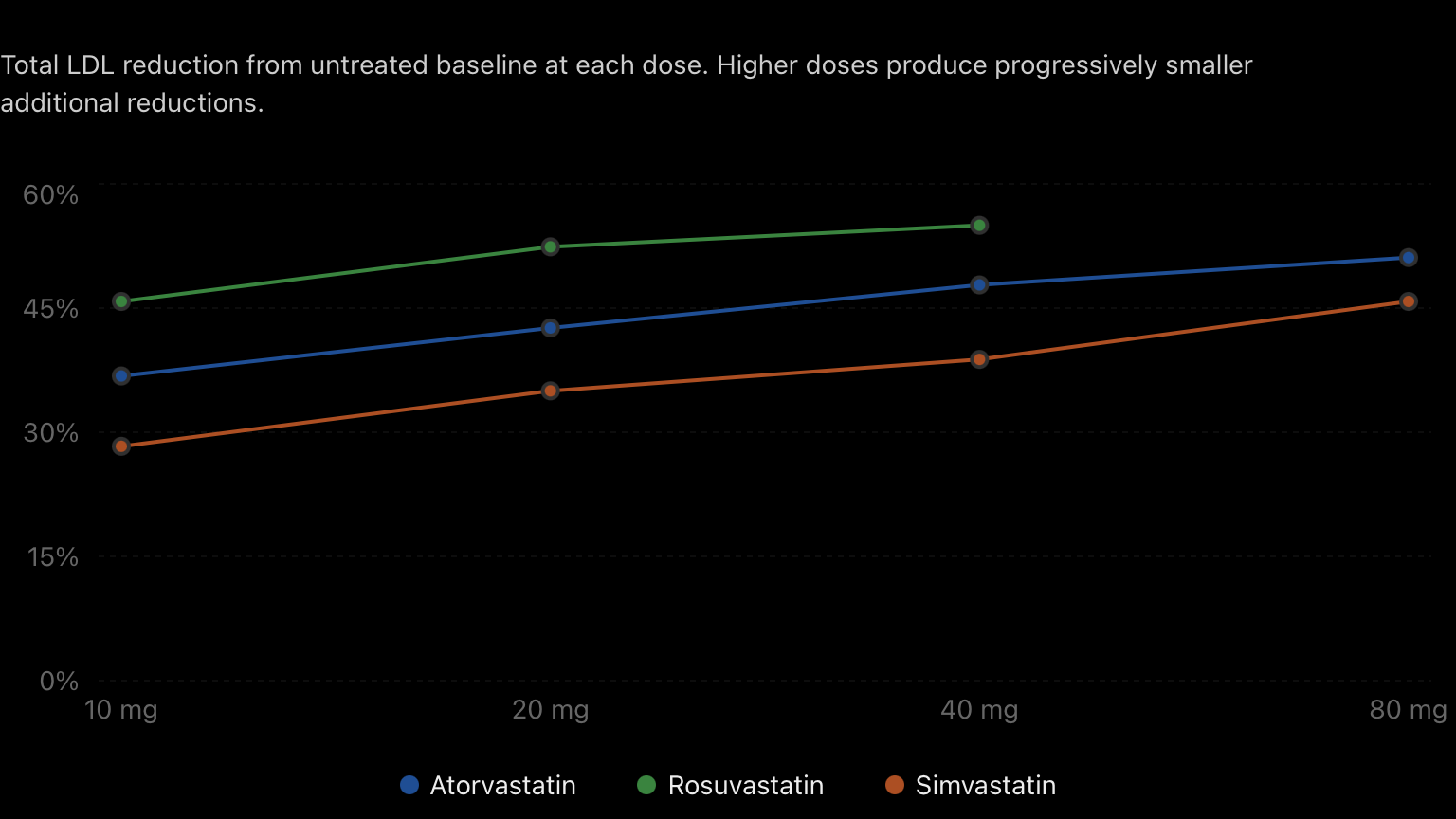
Its colored sections represent the additional reduction contributed by each successive dose. They are not separate total LDL reductions.
For example, atorvastatin produced approximately:
- 37% reduction at 10 mg.
- An additional 6 percentage points at 20 mg.
- Another 5 percentage points at 40 mg.
- Another 3 percentage points at 80 mg.
The total reduction at 80 mg was approximately 51%.
The chart's central message is supported by the STELLAR results.
One qualification: STELLAR was a six-week cholesterol-lowering study. It was not designed to determine which treatment strategy prevents the most heart attacks or deaths over the long term.
3. Why Adding Ezetimibe Can Be More Effective
Statins and ezetimibe lower cholesterol through different mechanisms.
Statins reduce cholesterol production in the liver and increase the liver's ability to remove LDL from circulation.
Ezetimibe reduces cholesterol absorption in the small intestine.
Combining the two can produce substantially greater LDL reduction than simply doubling the statin dose.
Research shows that adding ezetimibe to an existing statin regimen generally produces an additional LDL reduction of approximately 15–25%, measured against the LDL level already achieved with the statin.
Consider the difference:
- Doubling a statin dose: approximately another 6 percentage-point reduction from the untreated baseline.
- Adding ezetimibe: often another 15–25% reduction from the LDL level achieved with the statin.
These percentages use different reference points, but the practical difference can be considerable.
This is why combination therapy is an important option, particularly when someone needs a substantial additional reduction.
4. An Example: Increase the Statin or Add Ezetimibe?
Imagine someone whose untreated LDL is 100 mg/dL.
The initial statin dose reduces LDL by 40%.
Their LDL is now 60 mg/dL.
Consider two approaches.
Option A: Increase the statin dose
Doubling the dose might produce another six percentage-point reduction from the original baseline.
LDL falls from 60 to approximately 54 mg/dL.
Option B: Add ezetimibe
Adding ezetimibe may produce another 20% reduction from the LDL level achieved with the statin.
LDL falls from 60 to approximately 48 mg/dL.
Illustrative calculations, not guaranteed individual responses.
The difference is meaningful, particularly for someone whose cardiovascular risk makes a lower LDL target desirable.
5. Does This Mean Everyone Should Take a Lower Statin Dose?
No.
High-intensity statin therapy has a well-established role in reducing cardiovascular events, particularly in people with established cardiovascular disease and other high-risk conditions.
For some individuals, a high-intensity statin is entirely appropriate.
The point is not that lower doses are always better.
The point is that increasing the dose is not necessarily the most effective way to achieve a particular LDL target.
Other considerations include:
- Individual response to medication.
- Side effects and tolerability.
- The additional LDL reduction required.
- Overall cardiovascular risk.
- Cost and convenience.
- Evidence supporting cardiovascular benefits of the treatment combination.
Treatment should be individualized rather than based on the assumption that the highest possible statin dose is automatically the best choice.
Importantly, patients should not reduce or change prescribed statin doses without discussing it with their healthcare professional.
6. Does Combination Therapy Actually Reduce Heart Attacks?
This is an important question.
Lowering LDL is one thing. Demonstrating that a treatment reduces cardiovascular events is another.
The IMPROVE-IT trial, published in 2015, provides important evidence.
Researchers studied 18,144 patients following an acute coronary syndrome event.
They compared simvastatin alone with simvastatin combined with ezetimibe.
Adding ezetimibe lowered average LDL cholesterol to approximately 54 mg/dL, compared with approximately 70 mg/dL in the statin-only group.
Over a median follow-up of six years, the combination group experienced a statistically significant reduction in the primary cardiovascular outcome.
The absolute difference in events was modest, but the trial demonstrated that adding ezetimibe to statin therapy can provide additional cardiovascular protection.
This is important because it moves the argument beyond simply improving a cholesterol test.
It demonstrates that the additional LDL reduction can translate into fewer cardiovascular events in an appropriate high-risk population.
The findings should not be interpreted as proving that every person will benefit equally. The trial involved patients who had recently experienced an acute coronary syndrome.
7. What About ApoB?
Lowering LDL cholesterol is important, but LDL-C doesn't tell us everything.
ApoB provides an estimate of the number of circulating atherogenic particles.
Each LDL particle carries one ApoB-100 molecule, so ApoB can reveal situations where LDL-C and particle numbers do not tell the same story.
This is particularly relevant for people with elevated triglycerides, metabolic disease, or residual cardiovascular risk despite achieving their LDL target.
Ezetimibe can also reduce ApoB, although the magnitude of the reduction varies.
When deciding whether treatment is adequate, looking at both LDL-C and ApoB can provide a more complete picture.
8. The Bigger Question: What LDL Level Are You Trying to Reach?
Before deciding whether to increase a statin dose or add another medication, establish the appropriate treatment target.
The 2026 ACC/AHA dyslipidemia guidelines provide specific LDL targets based on cardiovascular risk and coronary calcium.
For example:
| Coronary calcium score | LDL-C goal |
|---|---|
| 1–99, below 75th percentile | Below 100 mg/dL |
| 100–299, or 75th percentile or higher | Below 70 mg/dL |
| 300–999 | Below 70 mg/dL |
| 1,000 or higher | Below 55 mg/dL |
For people with CAC scores of 300–999, more intensive treatment to below 55 mg/dL is also considered reasonable.
The guidelines also emphasize the importance of achieving an appropriate percentage reduction from untreated LDL levels.
For someone with extensive coronary atherosclerosis, reaching the appropriate target may require a combination of medications.
The objective isn't to take the largest statin dose possible. It is to achieve meaningful reductions in atherogenic lipoproteins and cardiovascular risk.
Watchdog Takeaway
Statins are among the most extensively studied and effective medications for reducing cardiovascular risk.
But more isn't always proportionally better.
The initial statin dose generally provides the largest share of the LDL reduction. Each subsequent dose doubling produces a relatively modest additional effect.
For people who need greater LDL reduction, adding ezetimibe or another appropriate nonstatin medication may be more effective than continually increasing the statin dose.
Three things worth remembering:
- Don't confuse dose with effectiveness. Doubling a statin dose does not double its LDL-lowering effect.
- Consider combination therapy. Medications that work through different mechanisms can produce greater LDL reductions.
- Treat the risk, not just the number. The appropriate LDL and ApoB targets depend on individual cardiovascular risk and existing atherosclerosis.
The best treatment isn't necessarily the strongest dose of one medication. It's the treatment strategy that achieves the appropriate reduction in cardiovascular risk with acceptable side effects and the least unnecessary treatment burden.
Evidence: STRONG
The diminishing returns of increasing statin doses and the additional LDL-lowering effect of ezetimibe are supported by clinical trials and systematic evidence. The cardiovascular benefits of adding ezetimibe have also been demonstrated in high-risk patients.
Sources and Further Reading
Jones PH et al. – STELLAR Trial (2003). Comparison of the efficacy and safety of rosuvastatin versus atorvastatin, simvastatin, and pravastatin across doses. American Journal of Cardiology.
Law MR et al. – Quantifying Effect of Statins on LDL Cholesterol (2003). Analysis of randomized trials examining statin dose and LDL reduction. BMJ.
Cannon CP et al. – IMPROVE-IT Trial (2015). Ezetimibe Added to Statin Therapy after Acute Coronary Syndromes. New England Journal of Medicine.
European Society of Cardiology – 2019 Dyslipidemia Guidelines. Evidence on LDL reduction with combination lipid-lowering therapy.
American College of Cardiology – 2022 Expert Consensus Decision Pathway on Nonstatin Therapies.
American Heart Association – 2026 Guideline on the Management of Dyslipidemia. Updated recommendations on LDL targets, ApoB, coronary calcium, and combination therapy.
https://professional.heart.org/en/science-news/2026-guideline-on-the-management-of-dyslipidemia
Senior Life Watchdog does not recommend starting, stopping or changing medication. Treatment decisions should be made with an appropriately qualified healthcare professional.