
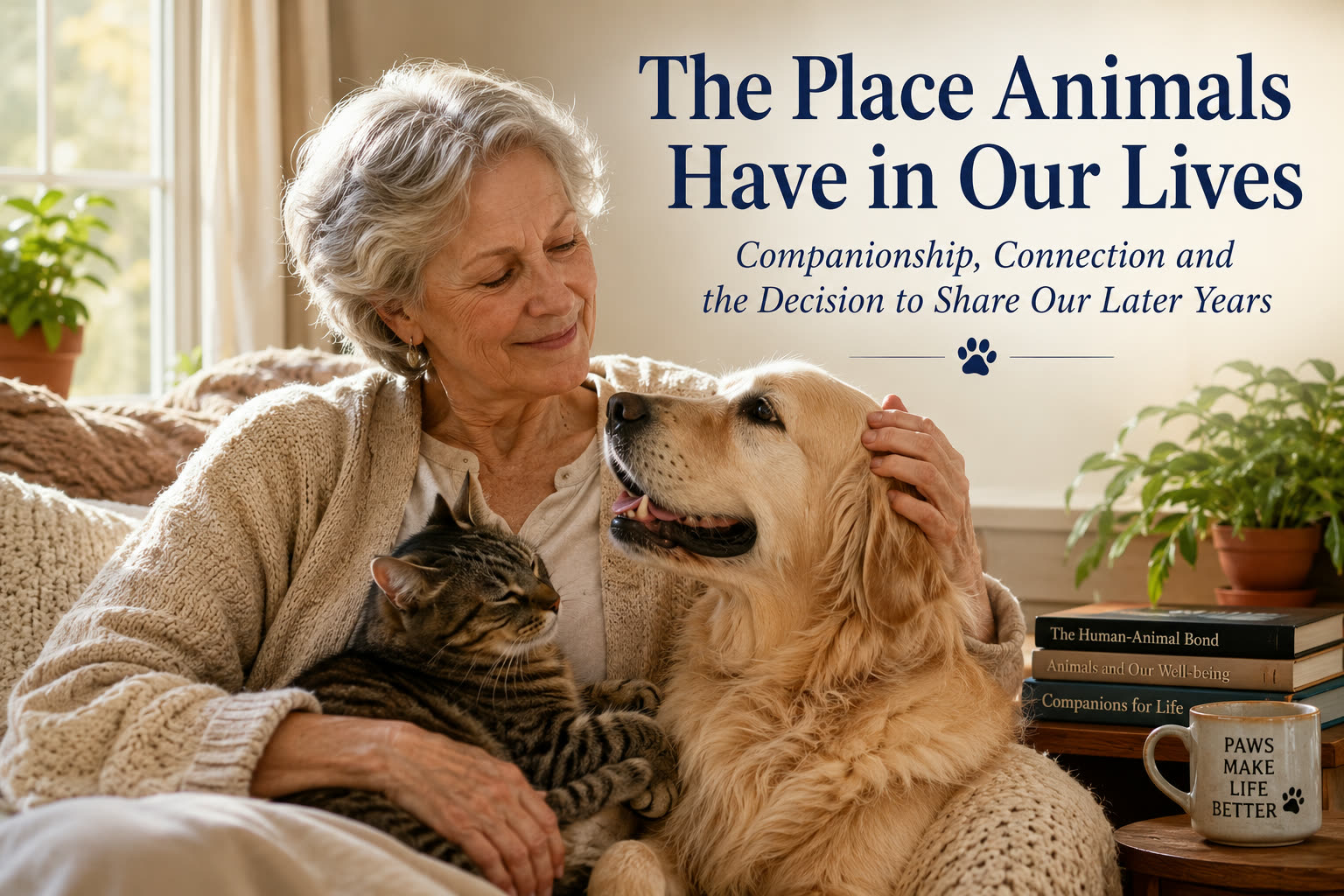
There is something rather remarkable about the relationship between humans and animals.
A dog doesn't care what we did for a living, how much money we have, what our opinions are, or whether we've achieved the things we once hoped to achieve. A cat doesn't ask us to explain our past or justify our choices. Animals meet us in the present, responding to our attention, our affection, our routines, and the care we provide.
For many people, that relationship becomes one of the most meaningful parts of life.
An animal can greet us with enthusiasm after an ordinary day, settle beside us during a quiet evening, or simply provide a reassuring presence in a home that might otherwise feel empty. The relationship may be uncomplicated in some ways, but it is rarely insignificant.
As we move into the second half of life, however, the question of sharing our lives with an animal deserves a little more thought. Our circumstances change. Work may no longer structure our days. Children may have left home. Relationships may change, friends may become less available, and the loss of a partner can leave an enormous space in everyday life.
Could an animal help fill some of that space? And what should we consider before inviting one into our lives?
The quiet value of companionship
Companionship is one of the most obvious gifts animals can offer.
A pet can provide a reason to get out of bed, a familiar presence throughout the day, and something to look forward to. Feeding, walking, grooming, and playing create routines that give the day a little structure.
For someone living alone, the presence of another living creature can make a home feel less empty.
But companionship isn't necessarily about loneliness. People with active social lives, loving families, and good friendships can still find enormous pleasure in sharing their lives with an animal.
There is something different about the relationship. It doesn't depend on conversation, agreement, or social expectations. We don't have to be entertaining, successful, or particularly interesting. We can simply be ourselves.
Sometimes that is exactly the kind of company we need.
Affection without the usual complications
Human relationships are wonderfully complex. They involve expectations, misunderstandings, compromises, disappointments, and the occasional argument over something that seemed important at the time.
The bond with an animal can feel different.
A dog may be delighted to see us whether we've had a successful day or a miserable one. A cat may choose to settle beside us without needing anything more than a comfortable place to sleep.
This is sometimes described as unconditional love. Perhaps that's a little romanticized. Animals have their own needs, preferences, personalities, and boundaries. Their affection is not a human emotion expressed in exactly the same way.
But the connection can feel remarkably accepting.
We don't need to explain ourselves to an animal. We don't need to maintain an image or pretend to be happier than we are. There is comfort in being accepted through familiarity and trust rather than through words.
That doesn't replace human relationships, nor should it. But it can provide a different and valuable form of connection.
When loneliness becomes part of life
Loneliness is not simply the absence of people. Someone can have family, friends, and regular social contact and still feel lonely. Equally, someone who spends considerable time alone may feel perfectly content.
What matters is the quality of connection, not simply the number of people around us.
An animal can help ease some feelings of loneliness by providing companionship, routine, affection, and a sense of being needed.
Walking a dog can also create opportunities for casual social interaction. Conversations begin naturally between people who might otherwise never speak. Familiar faces appear along the same routes, and a shared interest provides an easy starting point for conversation.
But we should be realistic. A pet is not a cure for loneliness, depression, or social isolation. An animal cannot replace a close friendship, a loving partner, or the deeper understanding that comes from human connection.
The best relationships with animals tend to enrich an already meaningful life, rather than carry the entire responsibility for making that life meaningful.
Having something to care for
One of the less obvious benefits of sharing our lives with an animal is the responsibility it brings.
Animals depend on us. They need food, water, exercise, attention, protection, and medical care. Their needs don't disappear because we're tired, distracted, or having a difficult day.
That responsibility can be demanding, but it can also give life a sense of direction.
As we get older, some of the roles that once gave our lives structure may change. Retirement can remove the routines and responsibilities associated with work. Children become independent. We may no longer feel as necessary to others as we once did.
Caring for an animal introduces a different kind of responsibility. Someone depends on us, and our actions make a difference to another living creature.
There can be meaning in that simple exchange.
It reminds us that our lives are not only about what we receive, accomplish, or experience. They are also about what we give.
What animals can teach us about living
Animals live much closer to the immediate present than most of us do.
A dog enjoying a walk isn't worrying about next month's bills. A cat sleeping in a patch of sunlight isn't regretting yesterday's mistakes or planning next year's ambitions.
Of course, animals experience fear, stress, anticipation, and memory. We shouldn't turn them into little philosophers simply because their behavior appeals to us.
Still, observing an animal can remind us of something easily overlooked: life is made up of ordinary experiences, not just major achievements and future plans.
A walk, a meal, a familiar place, a moment of affection, a comfortable afternoon. These things may seem small, but they are part of what makes a life.
Perhaps animals remind us that not every worthwhile experience needs to be productive, impressive, or directed toward some larger goal.
Sometimes being alive and enjoying the moment is enough.
The responsibility we shouldn't overlook
There is another side to this relationship, and it deserves equal attention.
An animal is not an accessory, a temporary distraction, or a solution to an empty house. It is a living creature whose well-being depends on the decisions we make.
Before getting a pet, particularly later in life, it is worth considering some practical questions.
Health and mobility. Can we manage daily walks, cleaning, feeding, grooming, and veterinary visits? What happens if our mobility changes?
Financial responsibility. Food, vaccinations, routine veterinary care, medication, grooming, boarding, and unexpected medical expenses can add up. Can we comfortably afford those costs?
Travel and flexibility. Will we have someone reliable to care for the animal when we travel or need to be away?
Housing. Does our home allow pets? Is there enough space, and is the environment suitable for the animal?
The animal's needs. A young, energetic dog may need considerably more exercise and attention than we can comfortably provide. An older or calmer animal may be a better match, but older animals can also have medical needs.
Changing circumstances. What happens if we become ill, need assistance, or can no longer care for the animal?
These aren't reasons to avoid having a pet. They're reasons to make the decision thoughtfully.
The animal's quality of life matters just as much as the companionship it provides us.
The difficult question of who comes next
There is one consideration that can be particularly important in the second half of life: what happens to the animal if we can no longer care for it?
This isn't an easy subject, but avoiding it doesn't make it disappear.
Pets can live for many years. A person adopting a puppy or kitten may be making a commitment that extends well into their later years.
It is worth thinking about who might take responsibility if circumstances change. A family member, friend, or trusted person may be willing to help, but that understanding should be discussed rather than assumed.
For some people, adopting an older animal may be a wonderful option. Older dogs and cats can offer companionship without the demands of raising a young animal. They may also have more predictable personalities and energy levels.
There are no guarantees, however. Older animals can require more veterinary care, and their remaining time with us may be shorter.
The important thing is to consider the needs and likely future of the animal, not just the pleasure of having one today.
There is more than one way to share our lives with animals
Owning a pet isn't the only way to experience the companionship animals offer.
Some people volunteer at animal shelters or rescue organizations. Others foster animals temporarily, help friends with their pets, or spend time with animals through community programs.
Fostering can be particularly rewarding, although it also requires time, patience, and an understanding that the animal may eventually move to a permanent home.
For someone uncertain about making a long-term commitment, these alternatives can provide a way to discover whether having an animal in their life feels right.
And sometimes the best decision is not to have a pet at all.
We shouldn't feel that an animal is necessary to make our lives complete. There are many ways to find companionship, connection, purpose, and meaning.
The decision should come from genuine desire and a realistic understanding of responsibility, not from pressure or the assumption that everyone needs a pet.
The meaning of being needed
Perhaps one of the most meaningful aspects of the human-animal relationship is the simple experience of being needed.
An animal doesn't need us to be wealthy, accomplished, attractive, or successful. It needs us to show up.
It needs us to remember its food, notice when something is wrong, make time for it, and provide a safe and caring home.
That may sound like a modest contribution, but it isn't.
As life changes, we sometimes spend too much time measuring our value by what we produce, what we own, or what we once accomplished. Caring for another living creature offers a different perspective.
Our value can also be found in the kindness we show, the responsibilities we accept, and the lives we make better.
An animal cannot tell us that in words. But the relationship can make the idea feel very real.
A few questions worth asking
If you're considering bringing an animal into your life, it may be worth taking a little time to think about what you're really looking for.
- Am I looking for companionship, a sense of purpose, more activity, or simply the pleasure of having an animal around?
- Do I have the time, energy, and financial resources to care for one properly?
- What kind of animal would suit my lifestyle and circumstances?
- Have I considered what might happen if my health or living arrangements change?
- Would fostering, volunteering, or helping someone with their pet meet some of the same needs?
- Am I prepared to make a commitment to this animal for the rest of its life?
There are no universal answers. The right decision will depend on the person, the animal, and the circumstances.
Sharing our lives, not just our homes
The relationship between humans and animals is one of life's quieter gifts.
It can bring affection into an ordinary day, companionship into a quiet home, routine into an unstructured life, and responsibility that gives us a reason to look beyond ourselves.
But perhaps the greatest value isn't simply that animals make us feel better. It's that caring for them gives us another opportunity to express something important about being human: our capacity to care for another living creature.
The second half of life doesn't have to be a period of withdrawal or diminishing connection. It can be a time when we become more aware of what matters, more selective about how we spend our time, and more appreciative of the relationships that enrich our lives.
For some people, sharing those years with an animal will be a deeply rewarding choice. For others, it won't be the right fit.
Either way, the question is worth considering.
Not simply whether an animal can make our lives better, but whether we can offer an animal a good life in return.
Because the most meaningful relationships are not just about what we receive. They're also about what we're willing to give.