
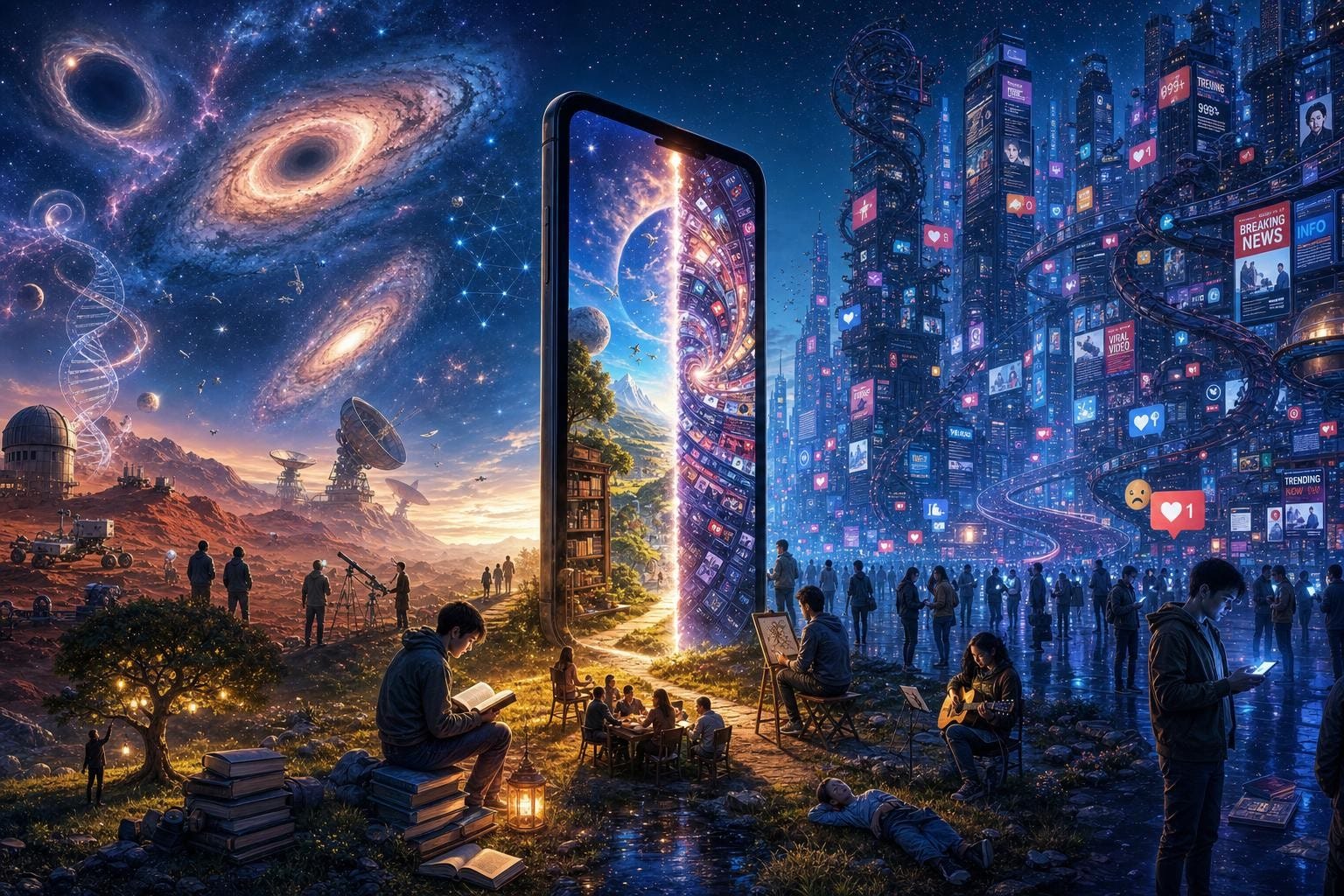
We are living through a strange and dangerous paradox: science is expanding our understanding of the universe to an almost unimaginable degree, while our technology is shrinking our inner world to the size of a screen.
This may be one of the defining contradictions of our age.
On one hand, we are seeing farther, deeper, and more precisely than any humans before us. We can detect gravitational waves from colliding black holes. We can photograph the shadow of a black hole at the center of a galaxy. We can read the genetic code of living things, map the human brain in extraordinary detail, send robotic explorers across Mars, and look back in time toward the earliest light of the cosmos.
The human mind has built instruments that extend perception almost beyond poetry.
And yet, at the level of daily life, many of us experience the world through a glowing rectangle a few inches wide.
We carry the universe in our pockets, but somehow the pocket keeps winning.
The Great Expansion
Science has given us an almost sacred enlargement of perspective.
It tells us that we live on a small planet orbiting an ordinary star in a galaxy of hundreds of billions of stars, itself one among perhaps trillions of galaxies. It tells us that the atoms in our bodies were forged in ancient stars. It tells us that life is not a static object but a process, a branching, adapting, improvising phenomenon billions of years in the making.
Science, at its best, is not merely technical. It is moral and imaginative. It teaches humility.
It says: you are not the center of the universe.
But it also says: astonishingly, you are part of it.
That double lesson — humility and belonging — is one of the greatest gifts modern knowledge has given us. We are tiny, yes. But we are not meaningless. We are the universe becoming aware of itself, however briefly, however imperfectly, however often while forgetting where we put our keys.
The deeper science looks, the stranger and grander reality becomes.
The cosmos is not smaller than our myths. It is larger.
The Great Contraction
But while science expands our outer vision, much of our consumer technology contracts our inner one.
The issue is not screens themselves. A screen can be a telescope, a library, a classroom, a concert hall, a map, a letter from a friend. The screen is not the enemy.
The problem is the economy behind the screen.
The dominant technologies of our time are not designed simply to inform us, connect us, or delight us. They are designed to capture and monetize attention. Their success is measured not by whether we become wiser, kinder, calmer, or more capable of wonder — but by whether we keep looking.
And so our attention is chopped into fragments.
A tragedy appears between a recipe and an advertisement. A war scrolls past a celebrity divorce. A scientific breakthrough is followed by a stranger’s outrage, followed by a joke, followed by a video of a raccoon washing grapes, followed by another reason to feel that civilization is ending.
The result is not knowledge. It is psychic weather.
We are exposed to more information than ever, but often with less context. More voices, but less silence. More stimulation, but less depth. More contact, but less communion.
We know the world is vast, but we increasingly encounter it as a feed.
When Everything Becomes Content
One of the quiet dangers of our age is that everything becomes content.
A sunset becomes a post. A meal becomes a photo. A private thought becomes a performance. A political catastrophe becomes a discourse cycle. Even grief becomes something to be formatted, captioned, and placed before an audience.
To be clear, sharing is not inherently shallow. Humans have always told stories, preserved memories, and sought witnesses for joy and pain. But there is a difference between expressing an experience and converting experience into material.
The first deepens life.
The second can begin to replace it.
When everything becomes content, the self becomes a brand manager of its own existence. We start asking, sometimes without noticing:
- How will this look?
- What will people think?
- Can this be shared?
- Will this be rewarded?
This is an exhausting way to live. It turns consciousness into a marketplace.
And a marketplace is not a soul.
The Loss of Interior Space
The deepest cost of constant digital stimulation may be the loss of interior space.
Interior space is the part of us that can wait, wonder, grieve, imagine, pray, reflect, and change. It is where meaning forms slowly. It is where conscience speaks before it becomes a statement. It is where a book works on us after we have closed it. It is where the night sky becomes not just “beautiful,” but quietly rearranging.
Interior space requires some degree of emptiness.
But emptiness is precisely what our devices rush to fill.
The moment we are bored, we reach. The moment we are lonely, we refresh. The moment a difficult feeling appears, we distract ourselves. The moment silence begins to gather, we interrupt it.
This matters because boredom is not merely a failure of entertainment. Boredom can be the doorway to thought. Loneliness can be the beginning of self-knowledge. Silence can be where buried truths finally become audible.
A culture that cannot tolerate silence will struggle to produce wisdom.
It may produce takes, reactions, opinions, and updates.
But wisdom requires a slower metabolism.
Science Gives Us Awe. Technology Gives Us Appetite.
Here is the paradox in its sharpest form:
Science gives us awe.
Technology gives us appetite.
Science asks us to contemplate deep time, cosmic scale, interdependence, uncertainty, and mystery. It trains the mind to move beyond immediate gratification. It rewards patience, doubt, and disciplined attention.
Consumer technology, by contrast, often trains the mind in the opposite direction. It rewards immediacy, certainty, novelty, outrage, and compulsive return.
One says: look longer.
The other says: look again.
One says: reality is more complex than you imagined.
The other says: here is a simplified enemy, a simplified identity, a simplified desire.
One opens the universe.
The other refreshes the feed.
No wonder we feel disoriented. We are being educated by two opposing systems at once.
The Political Danger of Shrinking Attention
This is not only a personal problem. It is political.
Democracy depends on attention. So does citizenship. So does moral responsibility.
A public that cannot sustain attention becomes easy to manipulate. It becomes vulnerable to slogans, spectacles, conspiracies, and emotional reflexes. Complex problems require patience: climate change, inequality, war, migration, technological disruption, public health, education. None of these can be understood in a 12-second clip or solved through ritualized outrage.
But the attention economy does not favor complexity. It favors intensity.
This means the most inflammatory version of reality often travels faster than the most accurate one. The most emotionally satisfying explanation can defeat the more truthful but more demanding account.
That is dangerous.
A society can become highly informed in the superficial sense — constantly updated, constantly alerted, constantly exposed — while becoming less capable of judgment.
Information is not wisdom.
Connectivity is not community.
Expression is not understanding.
And speed is not progress.
The Point Is Not to Flee Technology
The answer is not to smash our phones and move to a cabin where we churn butter and write letters by candlelight — though, depending on the week, one does see the appeal.
The point is not rejection. It is recovery.
We need technology. We benefit from it in countless ways. It allows families to stay connected across continents. It gives independent writers, artists, scientists, and teachers access to audiences they never would have reached before. It can democratize knowledge, expose injustice, coordinate aid, and create new forms of beauty.
The question is not whether we use technology.
The question is whether we are still capable of using it freely.
A tool becomes a trap when it no longer serves an intention.
A screen becomes dangerous when it stops being a window and becomes a wall.
Practices of Re-Expansion
If our inner world has been shrinking, then the work is to expand it again.
Not dramatically. Not perfectly. Not with the grim self-improvement energy of someone trying to become a productivity monk by Tuesday.
But steadily.
We can begin with small acts of resistance.
Read books that require something from you. Not just articles that confirm what you already believe, but books that slow you down and make you wrestle.
Take walks without headphones. Let the mind wander. The mind is not wasting time when it wanders. It is composting experience.
Look at the sky. This sounds almost embarrassingly simple, but it is not. The sky is the original antidote to narcissism.
Have conversations that are not secretly performances. Speak without preparing a post in your head. Listen without waiting to convert someone else’s sentence into your own clever reply.
Create before consuming. Even briefly. Write a paragraph. Sketch something. Cook. Practice an instrument. Fix a broken thing. Make contact with the physical world.
Leave some moments undocumented. Let life happen without turning it into evidence.
And perhaps most importantly: protect silence.
Silence is not emptiness. It is the room where the self can hear itself think.
Wonder as a Form of Resistance
Wonder may be one of the most underrated political and spiritual resources we have.
Wonder interrupts consumption. It cannot be easily monetized because it does not immediately want anything. It looks, listens, and lingers. It restores proportion.
A person capable of wonder is harder to reduce to a consumer.
A person capable of wonder is harder to trap in permanent outrage.
A person capable of wonder remembers that reality is larger than the algorithm’s version of it.
This is why science matters not only as a body of knowledge, but as a discipline of attention. To really understand even a little astronomy, biology, geology, or physics is to be reminded that the world is not built around our impulses. The universe is patient. The Earth is ancient. Life is intricate. Everything is connected to things we rarely notice.
Wonder widens the soul.
And right now, widening is necessary.
The Horizon Beyond the Screen
The tragedy of our age is not that we have screens.
The tragedy would be if we forgot that there is a horizon beyond them.
The same species that invented infinite scroll also built the James Webb Space Telescope. The same nervous, distracted, impulsive creature that checks notifications in bed can also decode the structure of DNA, compose symphonies, nurse the sick, plant forests, fall in love, and ask what it means to be alive.
We are not only addicts of distraction.
We are also makers of meaning.
The question is which part of ourselves our tools are training.
Science has opened a universe of terrifying beauty and almost unbearable scale. It has shown us that existence is older, stranger, and more magnificent than our ancestors could have imagined.
We should not meet that revelation with a shrunken soul.
We should meet it with attention.
With reverence.
With discipline.
With jokes, too, because the cosmos is vast and we are small mammals with calendar apps.
But above all, we should meet it awake.
The universe has not become smaller.
Only our habits have.
And habits can change.